For better or for worse, I have been a self-proclaimed Weezer super fan for pretty much 6 years now. I grew up hearing "Troublemaker" and "Island in the Sun" on the radio, and had the luck to get really into the band not too long before they would make their back-to-back comeback albums in 2014 and 2016, respectively. Unfortunately that rise in quality hasn't seemed to last beyond then, and liking Weezer is still an embarrassment I choose to bear, but it's songs like this one that make me remember why the hell I got into them in the first place (I'm trying my best not to litter this with sentimental clichés, but alas, my emotional attachment is too great).
Part of the reason I chose "Holiday" over any other song on The Blue Album is because I think it's as underrated as a song on that album could possibly get. Yeah, it's not "Buddy Holly" or "The World Has Turned And Left Me Here," but it's still a damn good song. It opens with a soaring melody that starts it flying out of the gate, bursting with hopeful optimism that mirrors its carefree lyrical content, before sinking back down on "but we don't understand anyway." Definitely indicative of the Beach Boys influence on Rivers at the time (which also shows up in the harmonies, of course). Also makes me realize how much I love melodies/chord progressions that just keep going up until finally they have to come back down, since that's present on this and the two other songs I've already talked about. I guess I'm easy to please.
The image of a guy dreaming about getting away, not giving a fuck about anything, not even bothering to pack, creates such a powerful aura of youthful optimism it makes me want to get up and do god knows what myself (me, the person who has half jokingly declared my desire to become a hermit on many occasions). At the same time, there's a certain fragility to the sentiment, since youth, like the capricious desire expressed in the song, is only fleeting. The narrator, in saying "on this road we'll never die," implies that he wants to live in this moment forever, and ignore the reality surrounding him. Overall, the theme of the song reminds me a lot of "Island In The Sun", though I enjoy "Holiday" much more since 1. I haven't heard it 1000 times, and 2. it has a lot of personality that pretty much all Green album songs are lacking in. Also, how many songs have been able to use the word bivouac? Not any others I can think of.
Rivers wrote this and "In The Garage" soon after getting a record deal, so there's also that layer to the interpretation. Viewed through that lens, the "strange and distant land" of which he speaks would be the music industry as a whole, and the possible success that would have awaited him. I prefer to think of it as a straight-up love song, but there's that.
This is definitely going to be a lot more than just a post about a song. Seeing as I am currently in the throes of a full-on obsession with this group (I'm a big nerd), I have a long story to tell in regards to them, so the song is really more of a placeholder than anything (though it's certainly not a bad song to represent them).
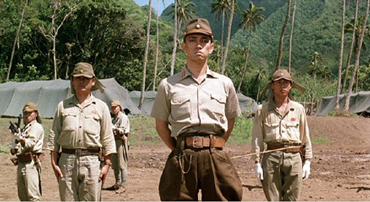
The events leading to my "discovery" of Yellow Magic Orchestra can be dated back a little less than a year, when I heard a performance of "Merry Christmas, Mr. Lawrence" (could have just made the post about that, couldn't I have) at a classical music concert. It stuck with me the most out of everything performed, though I didn't think much more about it until I decided to watch the film of the same name a few weeks ago essentially on 1. the merits of the song and 2. David Bowie. Sadly, neither of these were enough to carry the film, though I was surprised to see Sakamoto acting as one the main characters. So I guess if you're some kind of weird Bowie and/or Sakamoto superfan, that is the only condition under which I would recommend this.
*Bojack Horseman voice* what are youuuuu doing here??
But I digress. The 80s-ified synth version from the movie rekindled my interest and led me to look into Sakamoto's other work as a composer/musician, which inevitably led me to YMO. Fast-forward listening to 3 of their albums during an airport layover and here we are. It's funny to me that I got to this point through such an indirect way, like a weird pop-culture game of telephone. But then that's how a lot of things happen. Coincidence. Look at this, I'm monologuing again, as if this blog wasn't already nothing but monologue!
I've always had a great interest in synthesizers in general, since there's something about taking something so intangible and ethereal as electricity and turning into concrete sound that I find magical, as well as the possibility to essentially create whatever sound you want (though I am sure there are a whole bunch of technical limitations on this I am ignorant of). And yet I never listened to any synthpop of any kind up until this point because I'm so used to listening to music with lyrics, and deriving my enjoyment of pop/rock songs largely from their lyrical content, and because I associate lyric-less electronic music with ambient, sleepy stuff and repetitive music with little melodicism (I have to throw in that last part to distinguish it from other largely instrumental music like jazz-- which I don't listen to nearly enough of either). Yes, many YMO songs have lyrics, but in particular on their earlier albums it's pretty minimal so I don't count it in the same way. I'm making baby steps here.
The other reason I stayed away from electronic music is because I didn't think people were as creative with it as the seemingly endless possibility would suggest. A lot of the same sounding things seem to get reused. But YMO completely broke with any of these preconceived notions I had, and I was hooked the minute I hit play on "Yellow Magic (Tong Poo)," the name for the American release of "Tong Poo." I prefer the American release kind of in the same way I usually prefer the stereo remaster of a song that was originally in mono. Yeah, it's technically not as authentic, but it still sounds better to me. I don't care much for the random lyrical interlude in the American release, but the trade-off isn't big enough that I prefer the original.
This song actually feels kind of spare compared to some of their other stuff; it's not as loaded with layers as something like "Rydeen," though there's still a lot of little flourishes that come in and out. One of my favorite things about it is definitely that super funkadelic bass. There's also the way the end of the melody in the first part of the song lands on that unresolved note, only to go into the next section that keeps rising and rising until you finally hit that trill! Agh it's so good!! Something about the whole thing reminds me a theme song for an adventure movie. I could totally see it as a leitmotiv that comes on every time our heroes are faced with a challenge. Maybe it has to do with the way that the song is clearly divided up into segments, more like what I'd expect from an orchestral piece from a film score than a traditional pop song (I mean, "orchestra" is in the name of the group).
I thought I'd throw in this one last thing: at 49:25 in the video above, there's a clip of Sakamoto and his then-wife, Akiko Yano, playing the song as a duet on the piano, which I personally find wonderful.
The format of this blog is gonna be pretty straightforward, so mentioning at all in this first post seems kind of silly. Every week I'm taking a song and giving a long ramble I would usually save for whoever I decided to bother about it in person at that particular time. Maybe this will stop me from being such a nuisance. Or maybe I will find a loving internet audience. I doubt it. I'm starting with Underwear by Pulp only because I was listening to it a lot when I had the idea to start this.
Lyrically, to put it in simplest terms, "Underwear" deals with what is ostensibly a sexual encounter between two people and one or perhaps both of them realizing "oh shit this is really happening" without knowing how to actually deal with that. However, that description doesn't come close to fully giving it justice, which is why I have about three more paragraphs taking apart the damn thing.
The conceit of this having Jarvis as the narrator while simultaneously inside the head of the girl has always been really powerful to me because of how well he's able to make her anxiety about the situation tangible. It could be argued that he has no place narrating a woman's thoughts, seeing as he isn't one, but writers put themselves in the shoes of other people all the time (side note: if anyone knows of a woman writing a similar song, I'd be interested in hearing it). Jarv himself has often said in interviews that growing up surrounded by women (his mother and sister) has made him more sensitive to them (us, if I'm including myself) and their perspective, and that really shines through in this song.
Musically, I'm equally as enthusiastic about it. The slow, tense, chord progression in the verses goes up and down until BAM! you're hit by a blast of cheesy synths with the grandeur of a church organ in such a way that captures the feeling of being excited about the encounter, which quickly turns to misgiving and fear, back to that hopeful sounding E chord that suggests maybe everything isn't so bad after all. The airy cymbal at the tail-end of the song is just the icing on the cake for me. It definitely helps that I'm a big sucker for melodrama, of which there is no shortage in Pulp songs.
As someone who is very introverted and quite honestly terrified by just the thought of interacting physically with another human being, it is not hard for me to see where he was coming from on this one. It seems like he's sympathizing with the other party, and suggesting that he's every bit as anxious himself. While this was only the B-side to "Common People," I think it's every bit as good as the A-side, if not better (As an American I think part of that comes from the fact that Common People is so obnoxiously British I find it alienating).
That concludes my first entry of what will hopefully be many... praying that my writing will slowly improve with each one